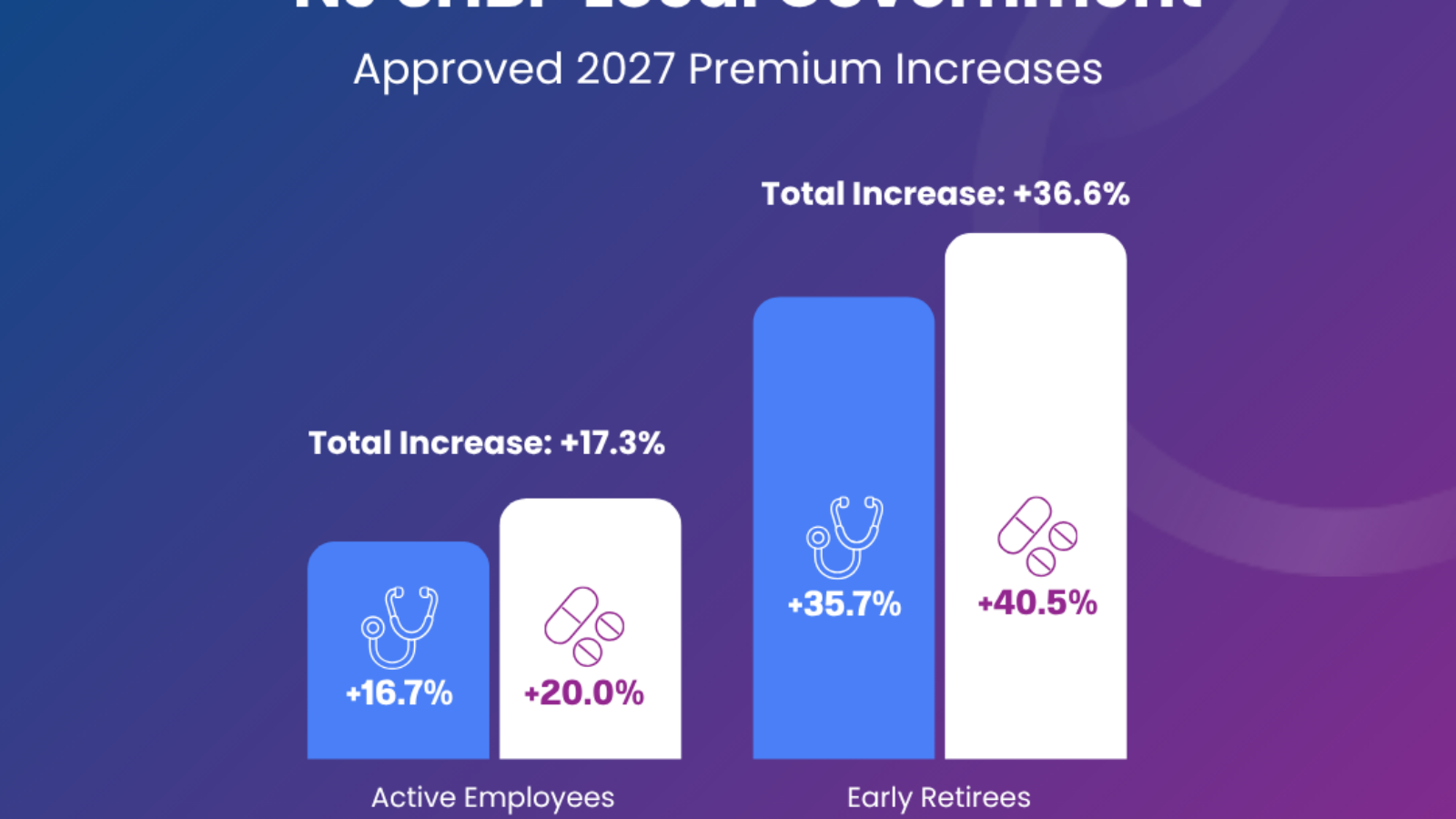
NJ SHBP Local Government 2027 approved annual healthcare premiums graph. This includes both medial and prescription drug benefit increases.

Update: NJ SHBP and SEHBP Rate Renewals – Where Do They Stand?

On September 3rd, the NJ School Employees’ Health Benefits (SEHBP) and State Health Benefits Programs (SHBP) resumed discussions to finalize the renewal rates for the 2027 plan year, with only the SHBP coming to a resolution.

The SHBP approved the combined rate recommendation for Local Government (LG) Actives, Early Retirees, and Medicare Retirees at a 22.1% overall premium increase — with a portion of the increase slated to repay prior funding obligations and rebuild depleted reserves, rather than just to cover projected healthcare costs. 

SHBP Local Government Approved Rate Renewals:

  • Active Populations: +17.3% Total Increase
    • +16.7% increase for medical
    • +20.0% increase for prescription
  • Early Retiree Populations: +36.6% Total Increase
    • +35.7% increase for medical
    • +40.5% increase for prescription

The SEHBP on the other hand, failed to approve any rates for the 2027 renewal year for a second time. The Commission deadlocked in a 4-4 vote on the recommended increases and agreed to reconvene in 2 weeks for another vote.

Benecard will continue to update you on any further developments with the final SEHBP 2027 rate actions as more information is released.

In the meantime, for organizations participating in the SHBP or SEHBP, now is the time to consider whether your current approach is delivering the cost control and financial certainty you need. Contact Richard Van Noord, Vice President of Sales, at Richard.VanNoord@benecard.com or (609) 651-5412 to explore what’s possible.

Sources:

NJ Panels OK Rate Hike for Public Worker Health Plans Deadlock on Increase for Teachers:

https://newjerseymonitor.com/2026/09/03/nj-panels-ok-rate-hike-for-public-worker-health-plans-deadlock-on-increase-for-teachers

Aon’s SHBP “Plan Year 2027 Rate Setting Recommendation Analysis” Local Government Employee Group Report (as approved on 9/3/2026):

https://nj.gov/treasury/pensions/documents/hb/rate-renewal/py2027-rate-setting-analysis-local.pdf

Plan Year 2027 Rate Renewal Reports:

https://www.nj.gov/treasury/pensions/rate-renewal.shtml

SEHBP Financial Challenges Persist Amid Unresolved Premium Rate Decisions – Benecard:

Image of a man and woman split screen left side image of woman and man losing hair. The right side of the image show regrowth of hair on both woman and man

The Next GLP-1? Why Hair Loss Drugs Could Be the Pharmacy Trend No One Saw Coming

Just as plan sponsors begin to gain their footing on GLP-1 management strategies, another emerging category is quietly advancing through the pipeline: hair loss treatment.

Historically, treatment options for pattern hair loss had limited choices at a modest costs, ranging from topical minoxidil (Rogaine®), to oral finasteride, and various off-label therapies. However, a new generation of non-specialty (VDPHL01) and specialty (PP405) medications are being developed that could significantly improve outcomes for both men and women experiencing hair loss.

Why Should This Concern Plan Sponsors?

Pattern hair loss affects approximately 80 million adults in the United States1, creating substantial utilization potential if these therapies receive FDA approval and gain market acceptance.

None of the medications discussed below are FDA-approved at this time, but they represent two pipeline products that could have meaningful clinical and financial implications for employer-sponsored health plans.

1. VDPHL01: Minoxidil 2.0

VDPHL01 is an oral, non-hormonal hair loss pill used to treat men and women.  The extended-release oral minoxidil tablet delivers hair regrowth benefits while avoiding the heart-related risks tied to immediate-release oral minoxidil. Phase 2/3 Study results released April 27, 2026 show strong efficacy signals, with robust hair growth seen in both once-daily and twice-daily dosing. Phase 3 studies are still being conducted.

If approved, VDPHL01 will become the first FDA-approved oral pill in nearly 30 years for treatment of pattern hair loss.2

VDPHL01 Estimated Market Availability: Late 2027 to early 2028. (pending successful completion of clinical trials and regulatory review).

Potential Financial Impact: Moderate to High

Plan sponsors should pay close attention because:

  • Oral medications are easy to prescribe and administer.
  • Clinical studies suggest meaningful hair regrowth benefits.
  • The eligible population includes both men and women.
  • Even a modest annual treatment cost can generate significant plan spend when multiplied across a large member population.

2. PP405: A Potentially Disruptive Stem Cell-Based Approach

PP405 represents a very different approach to treating hair loss. Rather than targeting hormones or improving blood flow, PP405 is designed to reactivate dormant hair follicle stem cells and stimulate new growth at the cellular level. The therapy is being developed for both men and women with pattern hair loss.

In a Phase 2 study, PP405 demonstrated a favorable safety profile with no treatment-related systemic adverse events reported. Phase 3 trials are expected to begin, although the product remains several years away from potential commercialization.3

Consumer excitement around PP405 has been substantial because it represents one of the first therapies seeking to regenerate hair growth by reactivating dormant follicles rather than slowing the progression of hair loss.

PP405 Estimated Market Availability: To be determined. The product remains in clinical development.

Potential Financial Impact: Moderate to High

From a pharmacy benefit perspective, this may be the more disruptive product.

If larger clinical trials confirm strong efficacy:

  • Demand could be significant.
  • Use could extend across a broad population of men and women.
  • Treatment may begin earlier in the disease progression process.
  • Specialty-drug pricing could place additional pressure on pharmacy budgets.
  • Physicians may view treatment as preventative rather than purely restorative.

How to Begin Assessing Your Rx Benefits Risk for Hair Loss Coverage

12-24 months before launch:

  1. Assess whether your current Rx and/or Medical benefits provide for hair loss treatments.
  2. For Benecard plan sponsors, have your brokers contact Benecard for the number of eligible members and their utilization based on any hair loss treatment usage from the most recent 12 months.
  3. Rethink Plan Design and Utilization Management Options for Hair Loss Category:
    1. Exclude
    2. Prior Authorization
    3. Step Therapy
    4. Member Cost Sharing

Although VDPHL01 and PP405 remain investigational therapies, both highlight a broader shift toward innovative treatments for highly prevalent lifestyle and quality-of-life conditions. For plan sponsors, the challenge will be balancing member access with responsible drug management tools in place prior to these drugs entering the marketplace.

Getting ahead of these therapies now allows organizations to thoughtfully design coverage and drug management strategies before high demand and additional cost increases arrive. To talk pharmacy benefit strategy, contact your Benecard Representative at talktous@benecard.com.

  1. https://medlineplus.gov/genetics/condition/androgenetic-alopecia/#frequency
  2. Veradermics’ Oral VDPHL01 Achieved Early, Consistent, and Robust Hair Growth in Positive Phase 2/3 ‘302’ Clinical Trial in Male Pattern Hair Loss | Mon, 04/27/2026 – 07:00
  3. https://www.dermatologytimes.com/view/reactivating-the-follicle-pp405-moves-toward-late-stage-trials-for-alopecia

Balance scale with green cash on left side and orange prescription bottle on right side

Get the Whole Picture on Level Funding: Look at The Advantages and Limitations

As plan sponsors and benefit consultants consider ways to reduce costs and gain flexibility for their health care benefits, the concept of level funding the prescription benefit is getting more attention. There are some advantages to level funding, as well as limitations, but a deeper dive also shows other funding arrangements may be better.

Level Funding Advantages

Level funding is a hybrid funding model that mixes elements of self-funding and may also include stop-loss protection. It features a fixed monthly cost billed to the plan sponsor, with total costs reconciled against actual claims at the end of the contract year. This funding arrangement can offer advantages over fully insured plans, such as the potential for refunds based on positive performance (at the PBM’s discretion) and benefit design flexibility. Conversely, this funding arrangement may offer some level of risk protection as an advantage over self-funding.

Level Funding Limitations

Level funding may include stop-loss insurance—either individual incident stop loss (per claim or per covered life), aggregate stop loss, or both—which help share the risk with the plan sponsor. This arrangement comes with several considerations that warrant careful evaluation:

  • If claims exceed the carrier’s stop loss liability at any point during the contract year, the plan sponsor will be 100% responsible for these additional costs, which would be beyond the fixed monthly costs they paid in that given contract year.
  • In some instances, the stop-loss carrier could impose limitations, such as adding an individualized high-cost deductible to the specific individual at risk or not covering the high-cost drug and leaving the plan sponsor with the financial risk to pay for it, referred to as lasering. 
  • If an adverse market event occurs, the PBM can increase the level-funded rates at any time in that given contract year or terminate the agreement with 30 days’ notice.
  • Reconciliation occurs six months after the end of the contract year to settle any differences in payments.

A Level Funding Alternative That Covers 100% of the Risk & Has A Proven Track Record

When it comes to guaranteeing the Rx benefit and taking on 100% of the risk, Benecard’s guaranteed cost, fixed rate program takes any potential concerns off the table by providing absolute budget predictability and returning 100% savings back to the plan sponsor. With a reliable and proven track record of working with public sector entities for nearly 40 years, our program offers:

  1. A fully guaranteed funding model, with no reconciliation or risk beyond the fixed monthly program charges (regardless of how high claims may rise), all underwritten specifically to the plan sponsor’s defined pharmacy benefit plan.
  2. No additional invoices for administration fees or clinical program fees, such as those for prior authorizations.
  3. 100% return of savings delivered back to the plan sponsor based on positive plan performance.
  4. Plan sponsors retain full autonomy of their benefits, without any lasering.
  5. Comprehensive clinical programs included as part of the standard program offering, at no additional charge.

With high trends in the industry along with more cost uncertainty, an offering that provides peace of mind without administration headaches, 100% return of savings for positive plan performance, monthly fixed program charges for budget predictability, and full plan sponsor control, is a strong alternative to the typical level funded or self-funded with back end stop loss models. Of course, we offer other funding arrangements to meet your needs.

If you would like to discuss more about how Benecard can help assist with 100% risk protection, budget predictability, plan design flexibility, and a return of savings offering, please reach out to us at talktous@benecard.com.

Sources:

https://npabenefits.com/disadvantages-of-level-funding

https://ethosbenefits.com/level-funded-health-insurance-pros-and-cons

https://www.hcaa.org/page/selffundingstoploss#:~:text=Stop%2Dloss%20insurance%20(also%20known,and%20aggregate%20stop%2Dloss%20coverage